
By: Ricky Rogers
There was a time when the gridiron belonged almost exclusively to the boys. The helmets, the shoulder pads, the marching bands, and the roar of the crowd were all part of a football tradition that has defined communities across the Chattahoochee Valley for generations.
But something is changing.
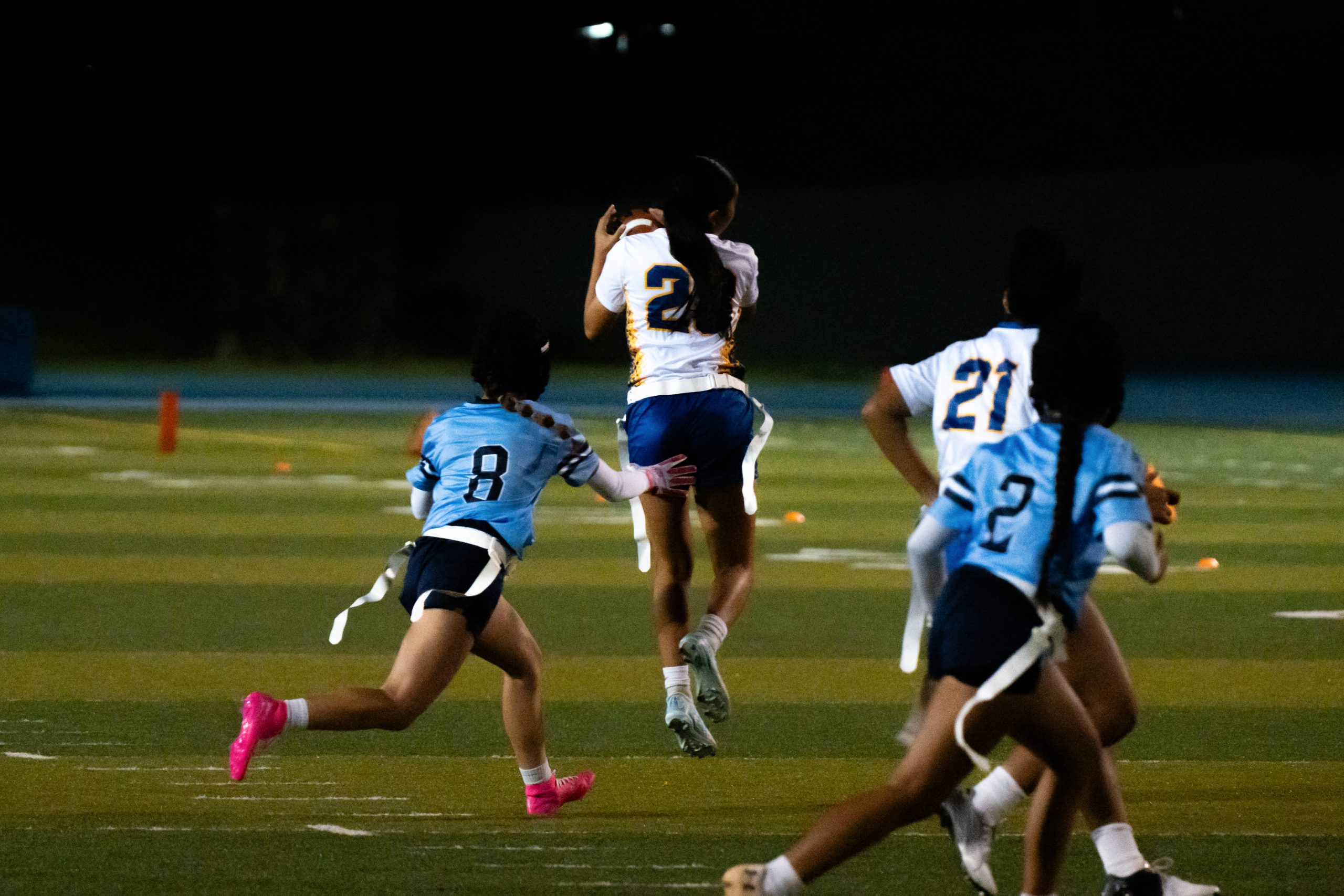
Across the region, a new generation of athletes is taking the field, throwing touchdowns, making game-saving defensive stops, and building traditions of their own. They aren’t wearing helmets or shoulder pads, but make no mistake about it. These young ladies are playing football, and they’re proving they belong.
Girls flag football is no longer simply an emerging sport. It’s becoming an important part of the high school athletic landscape, creating opportunities that barely existed a few years ago.
And here in the Chattahoochee Valley, the evidence of that growth can be found in two programs at very different stages of their journeys.
At Columbus High School, head coach Chris Grier has spent seven years building the Blue Devils into a championship-winning program that has helped establish the standard for excellence.
Just a few miles away, Calvary Christian School head coach JD Roberson is experiencing the excitement, challenges, and growing pains of building something entirely new.
One program is defending a tradition. The other is creating one.
Together, they tell the story of a sport whose future may be even brighter than its remarkable beginning.
But before either program could build its own tradition, someone had to open the door. In 2019, the Atlanta Falcons approached Muscogee County Schools about joining a Georgia pilot program intended to bring girls flag football into the state athletic association. Jeff Battles, then the district’s citywide athletic director, saw a chance to give female athletes another stage on which to compete.
“We have some amazing young female athletes in our school district who have excelled at a variety of sports, and this was one area where I knew we could succeed,” Battles recalled.
The first challenge was winning support from school administrators. Student interest surveys helped make the case, and professional development sessions prepared coaches to teach a game with rules different from tackle football. Battles remembers visiting practices before the first games and seeing players and coaches committed to learning.
“Everyone was serious, everyone was trying to learn and get better. That is when I knew that this was going to be good for our schools,” he said.
BUILDING A STANDARD
When Chris Grier accepted the challenge of leading Columbus High School’s inaugural flag football team in 2019, there was no established blueprint for success.
There were no championship banners to defend, no generations of former players to lean on, and very little certainty about what the sport might eventually become.
What Grier did have was a passion for football and an opportunity to introduce a group of young women to something new. “My love and passion for the game of flag football is really what drew me to it,” Grier recalled. “I saw an opportunity to share that passion with a group of young ladies who were getting the chance to be part of something brand new.”
The response was immediate.
More than 60 girls tried out for that first Blue Devils team. Only 20 could make the roster.
With limited preparation time and an entirely new group of athletes, Grier and his players quickly discovered that building a successful program would require more than simply putting talented athletes on the field.
It would require trust, commitment, and a willingness to embrace individual roles.
What followed was nothing short of extraordinary.
Columbus High captured both the inaugural Muscogee County championship and the Atlanta Falcons Flag Football Championship. Even more remarkable, the Blue Devils completed their entire Muscogee County School District schedule without allowing a single point.
They outscored their opponents 256–0.
For a first-year program, it was an astonishing accomplishment.
But perhaps the most important achievement of that inaugural season wasn’t found on the scoreboard.
It was the culture that began taking shape.
“We had over 60 girls try out, but we were only allowed to keep 20,” Grier explained. “We didn’t have much time to prepare, so we had to learn quickly, figure out everyone’s strengths, and put athletes in positions where they could be successful.”
That first team graduated 12 seniors, leaving just eight returning players to carry the program forward.
Rather than allowing the loss of so much experience to derail their momentum, those returning athletes became the foundation for everything that followed.
They understood what winning required. More importantly, they understood the responsibility of passing those expectations to the next group.
Seven years later, that formula continues to produce results.
The Blue Devils have compiled an impressive 107–19 record, according to Grier’s latest figures, establishing themselves as one of the area’s most accomplished flag football programs. But Grier believes the program’s sustained success has less to do with individual talent than with the expectations established from the beginning.
“Every year we have new faces, but the standard doesn’t change,” he said. “We’ve had some incredible athletes come through our program, but I think our success has been just as much about the girls buying into something bigger than themselves.”
For Columbus High, winning has become an expectation.
But the program’s greatest victories may be taking place long after the final whistle.
MORE THAN A GAME
For generations, young football players have dreamed of using their athletic abilities to earn college scholarships.
Until recently, that dream wasn’t nearly as accessible to girls who wanted to play football.
Flag football is helping change that.
As opportunities expand beyond the high school level, successful programs like Columbus High are demonstrating that the sport can become a legitimate pathway to higher education.
Four former Blue Devils have continued their flag football careers at the collegiate level.
Jamiese Spivey moved on to Emmanuel University, Serenity Hickman to Warner University, Cydnee Redd to Midland University, and Ashley Sajous to Huntingdon College.
Hickman has even experienced championship success beyond high school, becoming part of Warner University’s 2026 collegiate national championship program.
For Grier, those accomplishments represent something much more meaningful than another trophy.
“When we started this program in 2019, opportunities like these were extremely limited,” he said. “Now we’re watching young ladies earn scholarships and compete at the next level.”
And then there is the remarkable story of Alexandria Lofton.
A standout athlete at Columbus High, Lofton took her talents far beyond the Chattahoochee Valley, earning a place on Team USA’s Junior Olympic flag football team.
According to Grier, she was the only girl selected from Georgia.
She went on to represent the United States on the international stage and returned home with a gold medal. Think about that for a moment.
A young woman who began playing a sport that was still finding its footing at the high school level eventually represented her country and became an international champion.
Lofton received offers from every collegiate flag football program she pursued before ultimately accepting a full scholarship to Boston College to play soccer.
Her story illustrates just how dramatically the opportunities available to female athletes are changing.
For Grier, it also reinforces the purpose behind the program he started seven years ago.
“Championships are special, but helping these girls create opportunities for their futures is what it’s really about.”
That philosophy extends beyond athletic scholarships and championship trophies.
At Columbus High, accountability, discipline, teamwork, and personal development remain central to the program’s identity.
Grier wants his players to become successful young women, regardless of whether they ever play another down of football after graduation.
And while Columbus High has already established an impressive legacy, other schools throughout the Valley are beginning to write their own stories.
A NEW CHAPTER FOR THE KNIGHTS
While Columbus High has spent years building a championship tradition, Calvary Christian School is discovering what it means to start from scratch.
The Knights launched their inaugural flag football program this fall, joining the growing number of schools recognizing the sport’s potential.
For head coach JD Roberson, the journey actually began several years before the team’s first official practice.
Calvary had discussed adding flag football for two or three years. Strong participation in the school’s powder-puff football games and elementary intramural flag football activities suggested there was already considerable interest.
Eventually, school leadership decided to find out just how much.
An interest survey produced overwhelmingly positive responses, providing the encouragement needed to move forward. Even with that enthusiasm, getting the program off the ground wasn’t without challenges.
Changes within the athletic department contributed to a delayed startup process, and the team didn’t begin practicing together until mid-August.
A second interest survey in July and a subsequent meeting drew more than 30 interested students.
For Roberson, the numbers confirmed what the school had suspected all along.
The girls wanted an opportunity to play.
And once that opportunity arrived, the challenge became transforming a group of enthusiastic newcomers into a competitive football team.
“This program has been a labor of love for sure,” Roberson said.
Without the benefit of a summer practice schedule, the Knights faced a steep learning curve.
Players had to learn offensive formations, defensive responsibilities, route concepts, and the split-second decision-making that separates successful plays from missed opportunities.
Roberson embraced the challenge.
Rather than sheltering his young team from difficult opponents, he deliberately scheduled strong competition to accelerate their development.
His goal was to have the Knights prepared for GIAA competition, even if that meant enduring some frustrating early results.
And while the scoreboard hasn’t always reflected the progress being made, Roberson sees improvement with each passing week.
That progress recently produced a milestone the Knights will never forget.
Their first varsity touchdown.
THE TOUCHDOWN THAT MEANT EVERYTHING
For an established program, a touchdown might be just another six points.
For a team playing its inaugural season, it can mean something entirely different.
It represents countless hours of practice, mistakes corrected, lessons learned, and the realization that all the hard work is beginning to pay off.
Calvary’s breakthrough came against a talented, undefeated Shaw team. The Knights had come close to scoring in previous games, only to see promising drives stall because of a missed read, a dropped pass, or another small mistake.
But this time, facing fourth down, Calvary’s quarterback delivered the throw the team had been working toward.
And suddenly, the Knights had their first touchdown.
For Roberson, the play represented more than a successful offensive possession.
It was proof that his players were beginning to understand the game.
“Once the QB made that big throw on 4th down, I knew that it finally clicked,” he recalled.
Calvary operates an option-style offense that places considerable responsibility on its quarterback to recognize defensive alignments and make the correct decisions.
Those skills take time to develop, particularly for players who are still learning the sport.
But against Shaw, Roberson saw the results of weeks of preparation.
“I was just proud of them,” he said. “I see the potential of what they can do, and they have trusted the process every week.”
Despite facing an undefeated opponent with exceptional speed, the Knights remained competitive and continued battling until the end.
Afterward, Roberson delivered a message designed to reinforce the team’s progress.
“You girls gave them everything they could handle until the very end… we are right where we need to be.”
It’s a philosophy that places development ahead of immediate results.
Roberson believes the wins will eventually come.
For now, the focus remains on improving one play, one practice, and one game at a time.
“We don’t even look at the scoreboard; we just focus on doing our best every single snap, and the rest will unfold as it should.”
For Calvary, that first touchdown was a small piece of history.
But for the girls who scored it, and the coaches who helped make it happen, it was also a glimpse of what might be possible.
A COMMUNITY BEHIND THE GAME
Starting a new athletic program requires considerably more than finding players and a coach.
There are schedules to coordinate, equipment to secure, games to organize, and countless responsibilities that often go unnoticed by those watching from the stands.
Battles saw those behind-the-scenes demands firsthand during Muscogee County’s launch. He credits then-Superintendent Dr. David Lewis with helping secure coaching supplements, equipment, and other resources to give the new programs a sustainable foundation. School administrators bought in, coaches learned the sport, and athletes put in the work.
“Enough cannot be said about the effort our athletes and coaches put into preparing for each practice and competition,” Battles said.
At Calvary, Roberson has discovered that building a program is truly a community effort.
School administrators have attended home games, while parents involved in other sports have stepped forward to assist with game-day operations.
That support has helped ease the burden of establishing an entirely new team.
“The school community has rallied behind the team as Calvary does in every endeavor,” Roberson said.
For a program still in its infancy, that encouragement matters.
It provides the players with a sense that they are part of something important, something the entire school is willing to support.
Roberson believes the continued involvement of the Calvary community, affectionately known as Knight Nation, will be essential to the program’s long-term success.
But his goals extend beyond victories and losses.
Calvary’s athletic philosophy is closely tied to the school’s Christian mission, and Roberson views flag football as another opportunity to help young women develop their character, strengthen their faith, and prepare for life beyond high school.
“The opportunity to just be themselves,” he said when asked what he hopes the sport provides his players.
He wants those who dream of competing at the collegiate level to have every opportunity to pursue that goal.
At the same time, he hopes every player leaves the program having learned valuable lessons about perseverance, responsibility, and overcoming adversity.
“After graduation, I want them to look back and see how they matured, excelled, failed, learned, and kept going no matter what the game of life threw at them.”
It’s a perspective remarkably similar to the one Grier has embraced at Columbus High.
Despite the difference in their programs’ histories, both coaches understand that the true value of high school athletics cannot always be measured in wins and losses. THE NEXT GENERATION The rise of girls flag football represents something larger than the addition of another sport to the high school calendar.
It represents opportunity.
For some athletes, it offers a chance to compete in a game they have loved for years but previously had few opportunities to play.
For others, it provides an entirely new athletic experience, one that might uncover talents they never knew they possessed.
And for a growing number of young women, it offers a potential pathway to college athletics and opportunities beyond their hometowns.
In Muscogee County, that pathway now begins well before high school. Battles says the district has expanded flag football into its middle schools, with regular-season schedules, playoffs, and a championship game. Elementary school clubs have also introduced fourth- and fifth-graders to the sport.
“I believe the early interest will allow the area to continue to be successful at the state level,” Battles said. And with colleges increasingly offering scholarships, he believes young players have even more reason to keep developing their skills.
The success of Columbus High demonstrates what can happen when a school invests in the sport and gives its athletes the resources, coaching, and support necessary to succeed.
The arrival of Calvary’s program demonstrates something equally important.
The interest is still growing.
And the sport’s future will depend on both established programs continuing to raise expectations and new programs finding the support needed to get started.
Grier believes the next phase of growth must include expanded opportunities for younger athletes.
More youth programs. More competitive opportunities. More college scholarships. And continued investment from schools and communities.
“Flag football has grown tremendously, but I still think we’re just scratching the surface,” he said.
It’s an observation that should excite anyone who cares about the future of high school athletics in the Chattahoochee Valley.
Because if the sport has already produced championship programs, collegiate athletes, and an international gold medalist in such a relatively short time, imagine what the next generation might accomplish.
Imagine the young girl attending her first flag football game this fall, watching a quarterback throw a touchdown pass or a defender make a game-saving stop.
Imagine her realizing, perhaps for the first time, that she could be the one making those plays someday. That’s how traditions begin.
And that’s how sports grow.
MORE THAN A FLAG
At first glance, Columbus High and Calvary Christian School might appear to have very little in common when it comes to flag football.
One is a proven winner with championship credentials, an extraordinary record, and former players competing at the collegiate and international levels.
The other is a first-year program celebrating milestones that established teams might take for granted.
But look beyond the records and the accomplishments, and the similarities become impossible to ignore.
Both programs began with girls who simply wanted an opportunity to play.
Both are led by coaches who believe their responsibility extends far beyond teaching offensive plays and defensive schemes.
And both are helping establish a future in which young women throughout the Chattahoochee Valley have more opportunities to compete, develop, and pursue their dreams.
Seven years ago, Chris Grier couldn’t have imagined everything his Columbus High program would eventually accomplish.
Today, JD Roberson is standing near the beginning of that same journey, watching his Knights discover what they are capable of becoming.
There will be more touchdowns.
More championships.
More college opportunities.
But perhaps the most important accomplishment has already happened.
Girls throughout the Valley are being given another opportunity to step onto a football field, compete for their schools, and create something that belongs to them.
The flags may be small, but the opportunities they represent are enormous.
And across the Chattahoochee Valley, those flags are flying higher than ever.