
By: Ricky Rogers
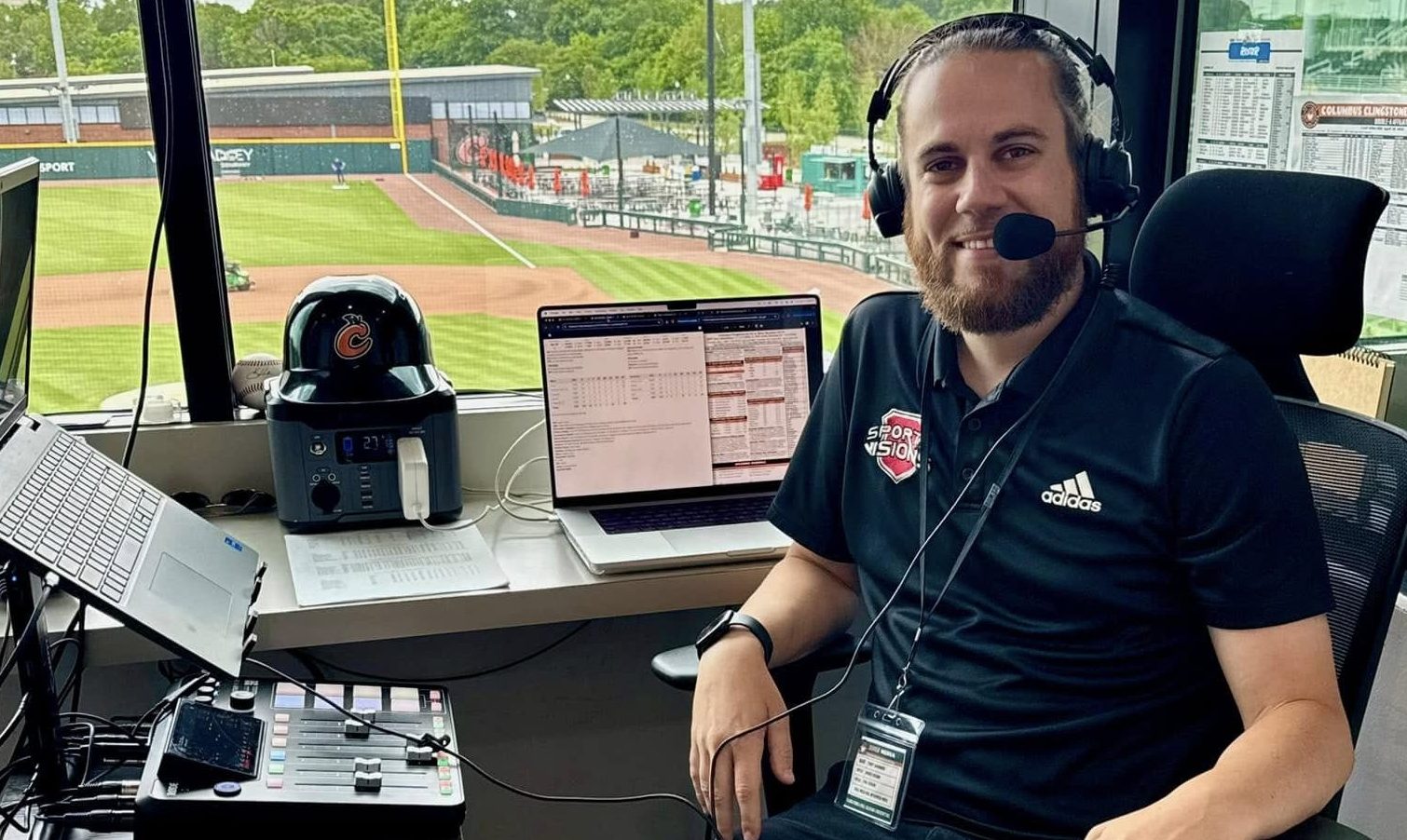
The remarkable story of Thrift Barringer, whose relentless work ethic and unwavering belief turned a cell phone and a dream into a growing sports media network.
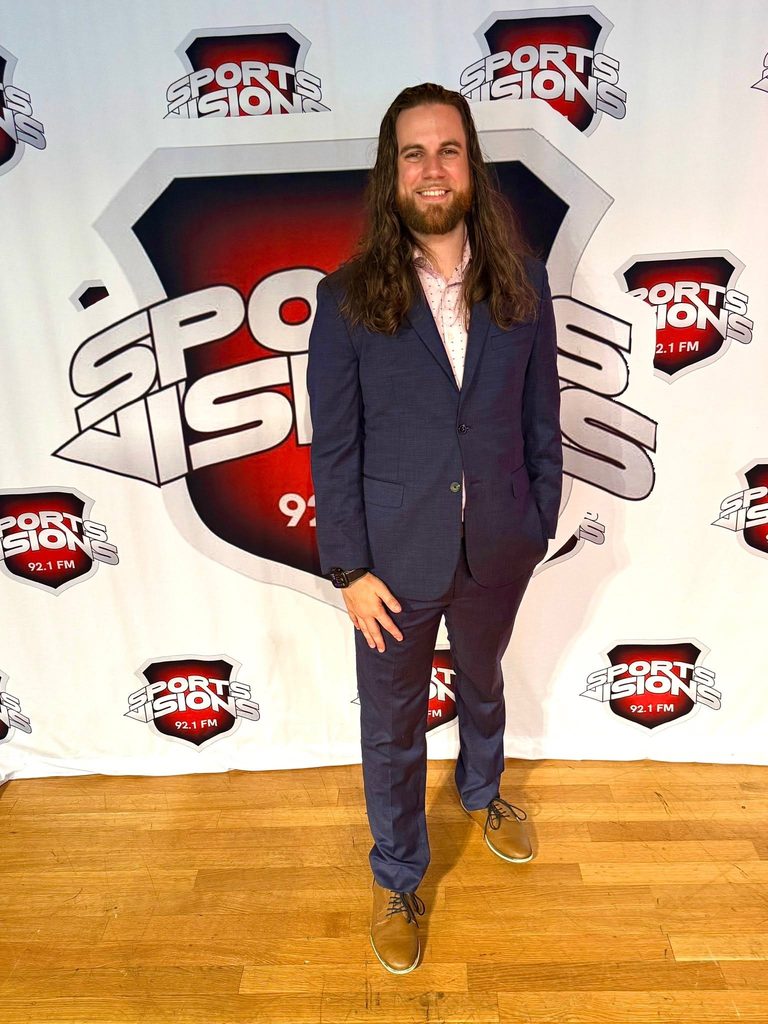
There was a time when Thrift Barringer thought he was having lunch with a rock star.
He was just a boy, sitting across the table from his grandfather, Coach Larry Bush, when someone would inevitably interrupt their meal.
Sometimes it was a handshake. Sometimes a hug. Often, it was a few words of gratitude from a former player who hadn’t worn a uniform in years.
It happened often enough that young Thrift began to understand something about the man sitting across from him.
People knew his grandfather.
More importantly, they remembered him.
Not simply because he had coached them. Not because of a particular victory or a championship season. They remembered him because, somewhere along the way, Coach Bush had made a difference in their lives.
And they wanted him to know it.
“I remember sitting there thinking I was having lunch with a rock star,” Barringer recalled. “And in my eyes, I was.”
At that age, Thrift couldn’t have understood everything those encounters represented.
He couldn’t have known that years later, he would build a career around celebrating young athletes, recognizing overlooked accomplishments, and creating opportunities for people whose stories might otherwise go untold.
He certainly couldn’t have imagined that a cell phone, a cheap tripod, and two $40 microphones would eventually become the foundation of a sports media organization reaching millions of viewers.
But perhaps the most important part of his future was already taking shape.
Because long before Thrift Barringer understood what he wanted to do with his life, his grandfather was teaching him what kind of life was worth living.
And nearly everything Barringer has built since can be traced, in one way or another, to the people who helped shape the man behind the dream.
THE MAN BEHIND THE NOISE
My first encounter with Thrift Barringer wasn’t particularly profound.
I was working as the public address announcer for Northside High School baseball when Barringer arrived to stream a game. We met briefly in passing, exchanging little more than the usual introductions.
But I remember my first impression vividly.
Damn, this guy is loud.
As it turns out, I wasn’t wrong.
Having gotten to know Barringer considerably better since that afternoon, I can confidently report that he hasn’t gotten any quieter. He’s still wildly spontaneous, endlessly energetic, and seemingly capable of having three conversations while simultaneously dreaming up his next big idea.
But something about my impression of him has changed.
I’ve discovered that beneath all that noise, the restless energy, and the seemingly endless stream of ideas is a man with an extraordinarily big heart.
And the more I’ve gotten to know Thrift Barringer, the more I’ve come to understand that his greatest quality isn’t necessarily his ability to make himself heard.
It’s his ability to make other people feel like they matter.
Spend enough time around him and you’ll quickly discover that Thrift doesn’t do much of anything halfway.
He talks fast. He thinks faster. And when an idea captures his imagination, there’s a good chance he’s already figuring out how to make it happen before everyone else has finished processing what he just said.
But there’s another side to that enthusiasm.
When Barringer talks about the athletes his organization covers, the people who work alongside him, or the individuals who helped him get started, the conversation becomes something more than business.
It becomes personal.
And to understand why, you have to go back to the beginning.
A DREAM THAT REFUSED TO WAIT
In 2023, Barringer was living two professional lives.
He worked full-time as a teacher while pursuing broadcasting opportunities through SportsVisions, where he learned under the mentorship of DJ Jones.
Those opportunities occasionally took him into some of college football’s most recognizable environments, including SEC giants Georgia, Auburn, and Alabama.
He loved broadcasting.
He wanted to make it his career.
But wanting something and finding someone willing to give you the opportunity are two very different things.
For Barringer, the waiting eventually became more frustrating than the uncertainty of doing something himself. Rather than continue hoping someone would open a door, he decided to create one.
There was no elaborate business plan or major financial investment.He had a phone, a cheap tripod, and two microphones that cost about $40 each.
So he started showing up at high school games and streaming them to his personal Facebook page.
The production was simple. The ambition behind it wasn’t.
Barringer had played basketball at Glenwood School, and he understood what it meant to compete without receiving widespread recognition.
He knew the feeling of being a young athlete who wanted someone to notice.
Now he was in a position to give other athletes something he had once wanted for himself.
Initially, he viewed the broadcasts as a way to gain experience and create opportunities in sports media.
But as families began watching and schools began embracing the coverage, his perspective changed.
What started as an effort to advance his own career was becoming an opportunity to serve an entire community.
In August 2023, Georgia Alabama Sports Live was born.
At the time, Barringer couldn’t have imagined how quickly the organization would grow.
He only knew that he believed in what he was doing.
And he wasn’t the only one.
THE PEOPLE WHO SHOWED UP FIRST
Success stories often become polished with time.
The uncertainty fades from memory. The difficult decisions become defining moments. The people who once wondered whether an idea would work begin talking about how obvious its potential had been all along.
But building something from nothing rarely feels inevitable when you’re the person doing it.
Barringer’s early days were filled with the ordinary difficulties of entrepreneurship.
There were games to cover, equipment to manage, relationships to build, and responsibilities that seemed to multiply with every new opportunity.
There were also people who believed in him before there was much evidence that his idea would become a successful business.
Among them were Toygar Ayla, Chris Gates, and Richard Holdridge.
They gave their time and energy to help establish GASL, often working long hours, after their full time jobs without compensation.
Their contributions weren’t glamorous.
They were foundational.
And Barringer has never forgotten them.
That willingness to remember the people who believed first is one of the qualities Tony Morgan admires most about his business partner.
“What people don’t see is how loyal he is,” Morgan explained. “Thrift remembers who believed in him early, and he protects those relationships even when it would be easier not to.”
Morgan says that loyalty influences the way Barringer approaches business relationships, partnerships, and decisions affecting the schools his organization serves.
For Barringer, relationships aren’t simply a means of achieving something.
They are part of what makes the achievement worthwhile.
“That is not a policy he wrote down one day,” Morgan said. “It is just who he is.”
In an industry where growth can sometimes make yesterday’s relationships feel less important than tomorrow’s opportunities, Barringer has worked to maintain a connection to the people who helped him begin.
And among those early believers was a woman whose influence would help change the course of his life.
THE WOMAN WHO TAUGHT HIM TO BET ON HIMSELF
Natalie Vega saw something in Thrift Barringer that he wasn’t yet entirely convinced he could become.
An entrepreneur herself, Vega recognized the potential in the broadcasts he was producing and encouraged him to approach the operation as something more than a hobby.
She understood that enthusiasm could start a business.
But belief, discipline, and commitment would be necessary to sustain one.
Her encouragement wasn’t limited to conversations about entrepreneurship.
She showed up at games.
She helped him with the phone he was using to stream.
She witnessed firsthand the modest beginnings of what would eventually become GASL.
And when Barringer began considering whether he could leave teaching to pursue the organization full-time, Vega was among those encouraging him to take the risk.
“She showed me what it looked like to bet on yourself,” Barringer said.
The decision wasn’t easy.
Teaching offered stability. Broadcasting offered possibilities.
One came with a predictable paycheck.The other came with uncertainty, responsibility, and no guarantee that the audience he was building would continue to grow.
But after GASL’s first successful year, Barringer made the leap.
He left his full-time teaching position and committed himself to the business.
He describes the decision as an act of faith.
And faith, he says, has remained central to the journey.
Barringer believes God directed him toward a purpose he hadn’t originally envisioned.
He had dreamed of becoming a broadcaster.
He hadn’t necessarily dreamed of creating an organization that would provide opportunities for dozens of other broadcasters while celebrating thousands of young athletes.
Sometimes, he discovered, the dream you begin pursuing isn’t the same one you’re ultimately meant to fulfill.
And sometimes, it takes someone else’s belief to give you the courage to find out.
LEARNING TO LEAD WHAT HE BUILT
The next challenge came from an unexpected direction.
GASL was growing.
Fast.
Schools wanted more coverage. Audiences were increasing. The broadcast schedule was expanding.
What had begun as a small operation was becoming something far more complicated.
Barringer found himself trying to manage nearly every aspect of the organization.
He was a broadcaster, salesperson, scheduler, producer, and problem-solver.
And the very qualities that had helped him launch the business—his energy, determination, and willingness to do whatever was necessary—were no longer enough to manage everything it was becoming.
He needed help.
More importantly, he needed to learn how to accept it.
That evolution accelerated when Tony Morgan entered his life.
Morgan had built and sold businesses of his own. After selling his companies in 2018, he believed his days of building organizations were behind him.
Then he met Barringer.
The two crossed paths while Thrift was covering GIAA schools, and Morgan began taking an interest in the young entrepreneur’s vision.
He saw more than a promising business opportunity.
He saw a man who genuinely cared about the communities he served.
Families could watch their children compete without paying for access. Schools were developing relationships with a media organization that wanted to celebrate their programs.
And the founder was personally invested in making it work.
“We went from one man streaming games to a full production team with real partners behind it,” Morgan said, “and Thrift still sets the tone for all of it.”
Morgan began offering advice.
Over time, that relationship developed into a business partnership and helped establish Varsity Sports Network, the parent company behind GASL and its expanding operations.
For Barringer, however, Morgan’s significance extends beyond business.He describes him as a mentor and almost an uncle figure.
Someone who challenged him to think differently.
Someone who helped him recognize that being an entrepreneur and becoming an effective CEO require different skills.
Barringer had already proven he could build something.
Morgan helped him understand how to lead it.
“He’s become almost like an uncle figure, a mentor, and somebody I didn’t even realize how badly I needed in my life,” Barringer said.
The relationship is rooted in mutual respect.
Morgan recognizes the qualities that make Barringer uniquely suited to the organization’s mission.
And he sees his own responsibility as helping create the structure that allows those qualities to flourish.
“Thrift is the reason it works,” Morgan said. “My job is to make sure he has what he needs to keep doing it.”
For Barringer, the lesson was profound.
He didn’t have to stop being the dreamer.
He simply had to learn that the biggest dreams are rarely accomplished alone.
THE PEOPLE BEHIND THE PICTURE
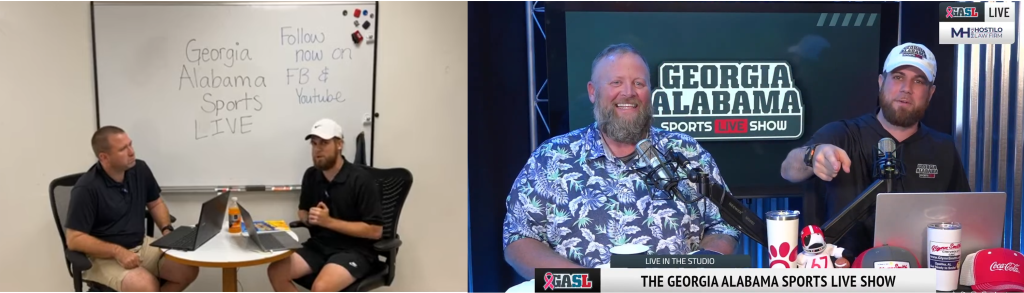
Today, Georgia Alabama Sports Live bears little resemblance to the operation Barringer launched in 2023.
More than 30 people now contribute to the organization, which partners with 17 schools and produces more than 700 live broadcasts annually.
Its coverage extends well beyond football and basketball.
Baseball, softball, volleyball, flag football,wrestling and other sports have become important parts of the programming schedule.
The result is a platform that celebrates athletes who might otherwise receive limited exposure.
Mike Frost, who has worked alongside Barringer in the broadcast booth since the 2025 football season, has a memorable way of describing his colleague’s motivation.
“He’s like Wu-Tang, he’s for the kids.”
It’s an unconventional comparison.
It’s also difficult to argue with.
Frost has watched Barringer’s enthusiasm for young athletes firsthand, particularly when it comes to programs that don’t always receive the attention given to more prominent sports.
He has also witnessed something that illustrates the organization’s impact.
At games, Frost has noticed students sitting in the stands while watching GASL’s broadcast on their phones.
They’re already at the event.
They can see the action happening in front of them.
But they’re listening to hear the announcers recognize their friends, teammates, and family members.
For those students, the broadcast has become part of the experience.
And for the athletes being recognized, it can make an ordinary moment feel extraordinary.
Mike Peacock, another GASL play-by-play broadcaster, believes Barringer’s passion for sports and his affection for the Chattahoochee Valley are inseparable.
“Thrift loves sports and that is first and foremost,” Peacock said.
But Peacock also recognizes the work required to deliver the organization’s productions.
Behind every broadcast is a group of people coordinating equipment, preparing information, managing technical details, and working to give viewers a professional experience.
Matt Melton, who joined the broadcast team at the beginning of the 2025–26 school year, was struck by that organization.
For all the spontaneity of the man who founded GASL, the productions themselves require preparation and coordination.
Melton understands that broadcasters have a responsibility to know the teams they’re covering.
That means studying rosters, learning about coaches, researching statistics, and identifying the stories that make each game meaningful.
But he also sees something beyond the immediate broadcast.
When Melton was growing up, high school games weren’t routinely available for families to watch from home.
Today, athletes can revisit performances long after their playing days are over.
A memorable touchdown.
A game-winning hit.
A championship celebration.
A senior’s final appearance in a school uniform.
These are moments that families may treasure for decades.
GASL is helping preserve them.
For Frost, the experience has also created something unexpected.
Friendship.
He describes the organization as another family, a place where relationships have developed alongside the work.
It’s a sentiment that speaks to the culture Barringer has helped establish.
The company produces sports broadcasts.
But the people producing them have become part of one another’s lives.
And Morgan believes that sense of connection begins with the founder.
“He also has a teacher’s heart,” Morgan said.
Barringer approaches an ordinary weeknight game with the same enthusiasm he brings to a championship event.
He cares about the athletes whose names may never appear in major recruiting rankings.
He understands that a small moment of recognition can become a lasting memory.
And although he left the classroom to pursue broadcasting, the desire to make a difference in young people’s lives has never left him.
A VALLEY WORTH BELIEVING IN
The growth of GASL has been remarkable.
During the 2025–26 school year, the organization generated 12,682,740 views across its digital platforms.
That represented a 170 percent increase over the previous year.
Audience interactions climbed to 158,620, an increase of 323 percent.
More than 10,700 new followers joined its platforms, while viewers accumulated over 87,000 hours of YouTube watch time.
Those numbers demonstrate the extraordinary appetite for local sports coverage.
But Barringer sees something more meaningful behind them.
He sees families.
Communities.
Schools.
And a region he believes deserves greater recognition.
The Chattahoochee Valley stretches across state lines, bringing together communities in Georgia and Alabama.
Its schools compete fiercely against one another.Its rivalries are deeply rooted. And its athletes wear different colors on Friday nights.
But Barringer believes those differences are part of a larger shared identity.
He wants the region to take pride in its accomplishments.
He wants young athletes to recognize that their communities are worth representing.
And he wants the stories being told through GASL to challenge the idea that meaningful athletic achievement happens only in larger markets.
His philosophy can be summarized in a phrase that has become something of a rallying cry.
“It’s the Chattahoochee Valley versus everybody.”
That pride has helped drive the organization’s expansion.
In fall 2026, Middle Georgia Sports Live launched as the first new market under Varsity Sports Network.
The operation has established partnerships with 11 schools and assembled a team of approximately 15 to 20 people.
For Morgan, the expansion represents an opportunity to build upon the approach that made GASL successful.
The goal isn’t simply to make the company bigger.
It’s to bring the same community-centered coverage to additional schools and families.
And Barringer continues looking ahead.
There are more opportunities to pursue, more stories to tell, and more young people who deserve to be recognized.
But ask him what makes him proudest, and he doesn’t begin with the audience numbers.
He begins with the people.
The team members who believed in his vision.
The broadcasters who bring passion to their assignments.
The individuals who work behind the scenes, often without public recognition.
The people who have taken something that began as one man’s dream and made it their own.
For Barringer, their dedication represents something no financial statement can adequately measure.
And it reinforces a lesson that has followed him throughout his life.
The most meaningful accomplishments are rarely individual ones.
THE WORK ETHIC OF A FATHER
If Coach Larry Bush gave Barringer his love of sports, his father gave him something equally important.
The determination to work.
Glenn Barringer has long represented an example of relentless effort to his son.
Thrift describes him as one of the hardest-working people he has ever known.
His father taught him that success doesn’t always belong to the most naturally gifted person.
It often belongs to the person willing to put in the work when others won’t.
That philosophy became especially important during GASL’s earliest days.
There were no guarantees. No established formula. No certainty that the business would survive. But Barringer understood the value of showing up, doing the work, and refusing to quit simply because something was difficult.
Those lessons remain part of the organization’s identity.
And when Barringer reflects on the people responsible for shaping him, he sees how their influence has combined.
His father taught him to work.
Natalie Vega taught him to believe in himself.
Tony Morgan taught him to lead.
His early colleagues taught him the power of shared commitment.
And his grandfather taught him something that gave meaning to all the rest.
THE MEASURE OF A MAN
Coach Larry Bush spent decades influencing young athletes throughout the Chattahoochee Valley.
His coaching career included time at Rothschild Middle School and Jordan High School, and his impact extended far beyond the teams he led.
Barringer remembers the championships and the accomplishments. He remembers the lessons. But most of all, he remembers the people.
The former players who approached his grandfather years after their playing days had ended.
The men who still wanted to shake his hand.
The people who had become adults, built careers, raised families, and continued carrying something their old coach had given them.
To young Thrift, those encounters were proof that his grandfather was important.
Today, he understands that they represented something much greater.
They were evidence of a life spent investing in others.
“My love for sports comes from my granddad,” Barringer said.
And so much of the person he has become, he believes, can be traced to the example Coach Bush set.
Barringer is proud of the organization he has built.
He is grateful for its growth and excited about its future.
But he doesn’t speak about his grandfather as someone whose accomplishments he hopes to surpass.
He speaks about him as someone whose example he hopes to honor.
“I don’t care how successful Georgia Alabama Sports Live becomes, how many people know my name, or how big this company grows,” Barringer said. “I’ll never be as big of a deal as my granddad is in my eyes.”
Consider that statement for a moment.
Here is a man who has built a growing sports media organization from almost nothing.
A man whose company reaches millions of viewers.
A man whose work gives countless young athletes an opportunity to be recognized.
And when he considers what it means to be truly successful, his thoughts return to a childhood lunch table.
Not to a boardroom.
Not to an audience report.
Not to a broadcast booth.
To a table where a boy watched strangers approach his grandfather simply to say thank you.
WHAT REMAINS AFTER THE GAME
There is a temptation to measure Thrift Barringer’s story by how far Georgia Alabama Sports Live has come.
The humble beginnings make for an appealing narrative.
One man. One phone. A cheap tripod. Two microphones. Millions of viewers.
It’s the kind of progression that makes people believe almost anything is possible.
And in many ways, that’s exactly what Barringer hopes his story demonstrates.
But reducing his journey to a story about entrepreneurial success would overlook the very thing that makes it meaningful.
Thrift Barringer didn’t build GASL by himself.
He knows that.
And he wants other people to know it, too.
He remembers DJ Jones, who helped him develop as a broadcaster.
He remembers Toygar Ayla, Chris Gates, and Richard Holdridge, who gave their time when the organization was still finding its footing.
He remembers Natalie Vega, who believed his dream was worth pursuing before he was certain he could pursue it.
He values Tony Morgan, who helped him become the leader his growing organization needed.
He carries the work ethic his father instilled in him.
And he continues to look up to the grandfather who taught him that the greatest accomplishments are measured in the lives we touch.
Those relationships aren’t footnotes to his success. They are the story.
And perhaps the most meaningful thing Barringer has accomplished is finding a way to pass along what those people gave him.
A young athlete receives recognition.
A broadcaster gets an opportunity.
A family watches a loved one compete.
A community celebrates a moment that might otherwise have gone unnoticed.
And somewhere, without necessarily realizing it, Barringer may be making the kind of difference that once inspired him as a child.
I think back to my first impression of Thrift.
Damn, this guy is loud.
I still believe that.
But I’ve come to understand something else.
Sometimes the people who make the most noise are also the ones who care most deeply about making sure others are heard.
And beneath the constant motion, the big ideas, and the enthusiasm that rarely seems to have an off switch, I’ve discovered a man whose heart is every bit as big as his dreams.
There may come a day when the name Thrift Barringer is known far beyond the Chattahoochee Valley.
There may be more markets, more broadcasts, more schools, and more remarkable numbers.
But I suspect the achievement that would mean the most to him won’t appear on an annual report.
It will happen years from now, when a former athlete, broadcaster, or colleague sees him somewhere and takes a moment to say thank you.
Not for a particular game.
Not for a championship broadcast.
But for believing in them.
For giving them an opportunity.
For making them feel like they mattered.
And if that day comes, Barringer will have accomplished something far greater than building a successful company.
He will have continued a legacy.
Because once upon a time, there was a little boy sitting across from his grandfather, watching grown men approach their table to express their gratitude.
He thought he was having lunch with a rock star.
He didn’t yet understand that the real measure of the man wasn’t how many people knew his name.
It was how many people remembered the difference he made.
Today, Thrift Barringer is building something that gives others a chance to be seen, celebrated, and remembered.
And maybe, just maybe, somewhere down the road, a young person will look at him with the same admiration he once reserved for his grandfather.
If that happens, I suspect Thrift will understand exactly what it means.
Because no matter how big his company grows, how far his influence reaches, or how many people come to know his name, there will always be one man he considers larger than life.
Coach Larry Bush.
“He’ll always be my hero.”
Press Box Perspectives is a weekly feature of Georgia Alabama Sports Live, exploring the people, stories, and issues that shape athletics throughout the Chattahoochee Valley.